Scientists have made a major breakthrough in a new analysis of data from NASA’s old Galileo mission. For the first time, Jupiter’s icy moons have been identified.
A vast ocean lies beneath Europa
Beneath Europa’s thick icy crust lies a deep saltwater ocean, estimated to contain more water than all of Earth’s oceans combined. This chemical-rich ocean has long fascinated scientists, making Europa one of the most important locations for the search for extraterrestrial life.
In a new study of data from NASA’s Galileo mission, scientists have confirmed the presence of ammonia-containing compounds on Europa’s surface. Ammonia contains nitrogen, which plays a crucial role in the formation of life.
Date of Galileo mission
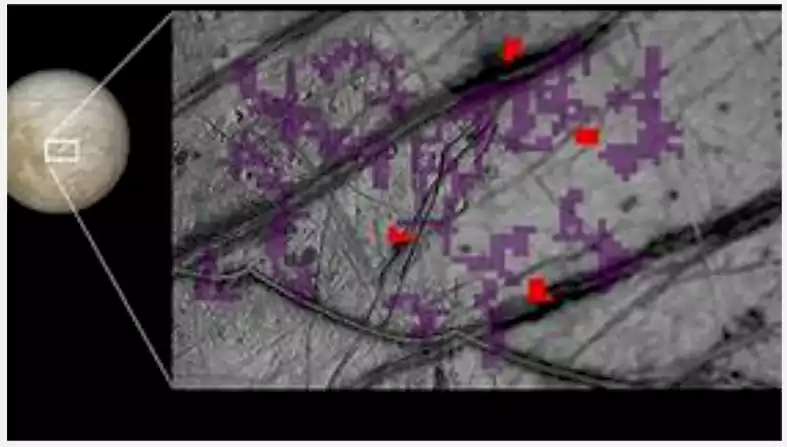
According to NASA, researchers identified weak spectral signals associated with ammonia in data from the Galileo spacecraft’s 1997 flyby of Europa. The composite image created by NASA highlights in red the areas where ammonia is detected on Europa’s icy surface.
Europa’s surface is covered in a network of deep cracks and ridges, and these ammonia signals have been found associated with these cracks. Scientists believe thatOf
Why ammonia strengthens the possibility of life
Ammonia significantly lowers the freezing point of water and can be rapidly destroyed by radiation. Therefore, its presence on the surface indicates that it has recently been exposed to the atmosphere.
The presence of ammonia is also considered important because it contains nitrogen, one of the essential elements for life. In the future, NASA’s Europa Space Center will be,
Overall, this discovery further elevates Europa to the list of strongest contenders for life in the Solar System.