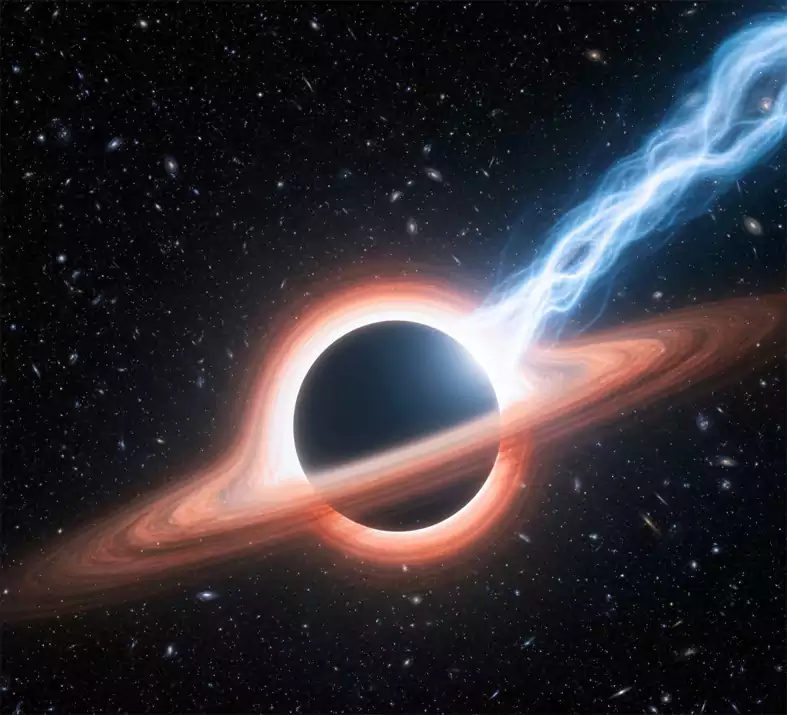
Black holes, one of the most powerful forces in the universe, are often known for swallowing everything in their path. But sometimes, these black holes also spew out flames (plasma jets) billions of kilometers long, like a ‘cosmic torch’. For years, scientists have been trying to solve the mystery of where these jets originate. Now, the Event Horizon Telescope (EHT) has provided the answer.
A Mysterious Jet 3,000 Light-Years Long
M87* is the same black hole whose first image was revealed to the world in 2019. It is 6.5 billion times more massive than our Sun. The plasma jet emanating from its center is so massive that it stretches for about 3,000 light-years. This jet is composed of charged particles traveling at near-light speeds (relativistic speeds).
What Did the New Discovery Reveal? (The Direct Link)
Scientists re-analyzed the EHT data from 2021. This time, they added some new ‘baselines’ to the telescope network, making the image much clearer than before.
Direct Connection: Previous images only showed the bright ring (shadow) around the black hole. But now, scientists can see that ring and the starting point (base) of the jet together.
Distance: According to the research, the main source of the jet is located only 0.09 light-years away from the black hole. This is extremely close to the black hole’s ‘event horizon’ (the point from which even light cannot escape).
Why is this discovery important?
This discovery helps us understand how black holes generate such tremendous energy. Energy source: This proves that the energy powering the jet comes from the magnetic field and the swirling clouds of hot gas (accretion disk) located very close to the black hole.
Galaxy evolution: These jets don’t just emit light; they also influence the evolution of their entire galaxy and the process of star formation.
Future prospects:
The scientists leading this research team say this is just the beginning. By expanding the EHT network in the future, we will be able to create “live video”-like imaging of the jet’s formation. This will help us understand how a black hole acts like an “engine” that powers some of the most extreme structures in the entire universe.